Turn the Yuma Depot Into an Arizona Logistics Math Lesson
Could a delayed wagon or missing crate turn local history into the math problem your child finally wants to solve?
The depot’s supply story gives learners a reason to use rates, inventory, distance, and estimation in a historical setting.
A depot is a math story waiting to happen: supplies arrive, people use them, travel takes time, and delays change the answer. Yuma gives those calculations a real historical setting.
The quick answer
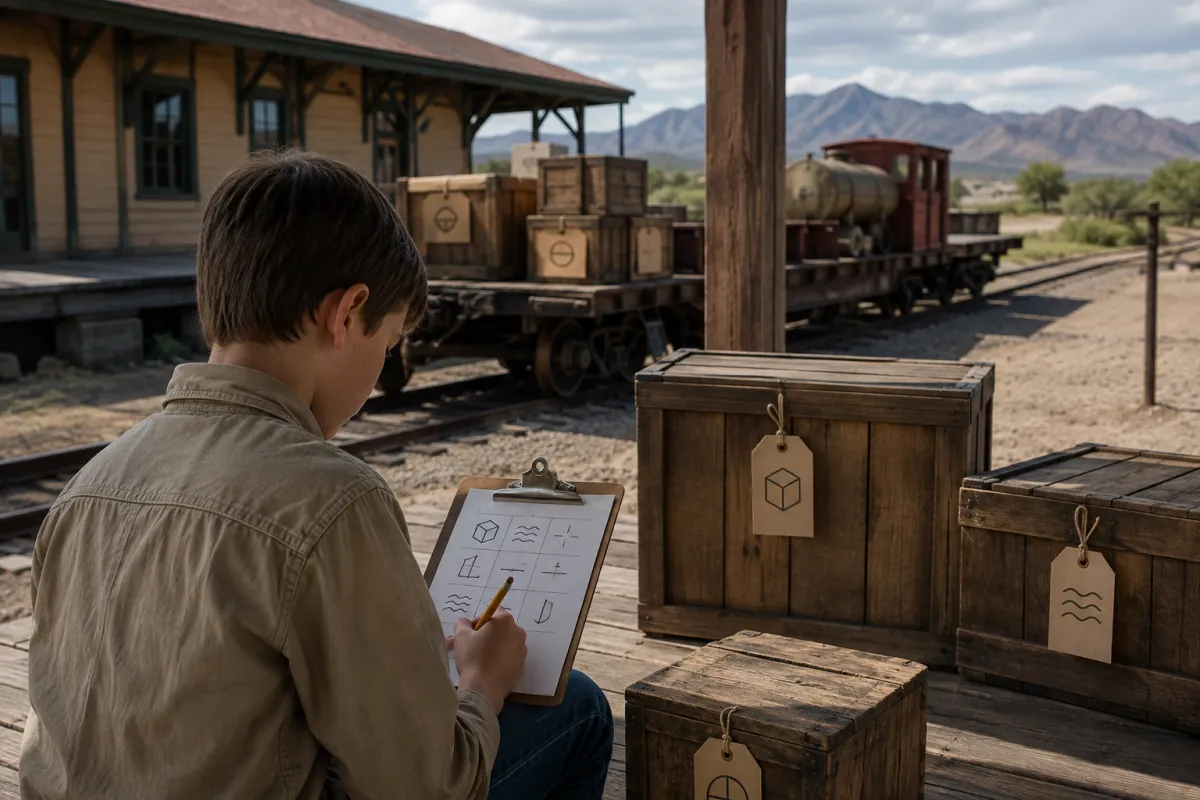
Do this first: Start with the park’s account of a depot serving faraway military posts. Create an age-appropriate fictional shipment with quantities, pack sizes, travel days, and daily use rates, then test whether the shipment is sufficient.
What the official source confirms
Colorado River State Historic Park offers a downloadable Junior Ranger activity based on Morse code and the history of the Yuma Quartermaster Depot.
The park says children ages 6 through 12 can complete activities, have their work reviewed by a ranger, take the Junior Ranger pledge, and receive a button. Arizona State Parks notes that Junior Ranger opportunities are available at nearly all state parks.
The historic park occupies part of the Army depot established in 1864, which supplied military posts across the Southwest. Families should verify current programs, hours, fees, heat guidance, and accessibility before traveling.
Check before you act: Confirm the current park hours, fees, heat guidance, activity availability, and age fit before traveling. Treat the activity page as a starting point, not a promise that every program is running that day.
Turn it into a lesson
Separate historical facts from invented numbers used for the math model.
Show units in every calculation and round only at the end.
Change one constraint such as delay, loss, or demand and explain the operational effect.
Finish with a shipment worksheet that separates historical facts from invented quantities and shows every unit.
The question that keeps curiosity alive
Which numbers are facts and which are assumptions?
Are the units consistent?
How does the answer change when one constraint changes?
Give the learner time to wonder before offering the next prompt. The unexpected observation is often more valuable than the answer you planned to hear.
Make it fit your learner
For an early learner, use fewer materials and repeat one clear comparison instead of adding more vocabulary.
For a teen, require units, a reproducible method, and a written boundary between the model and the real-world system.
Reduce volume before reducing thinking. One carefully examined object or variable can still support a serious conclusion.
Three traps to avoid
Trying to cover the entire topic in one sitting.
Mixing documented facts with invented numbers or assumptions.
Finishing the worksheet without asking the learner to explain the evidence.
What success looks like
The real payoff is growth in unit reasoning, estimation, and transparent assumptions. A strong finish is not a perfect page; it is a learner who can show how an idea changed when better evidence appeared.
Ask the child to describe the method, point to the strongest evidence, correct one early idea, and name the next sensible question.
Try this first
Set out a small fictional shipment with quantities, pack sizes, travel days, and daily use rates. Write the learning question at the top of the page, complete the smallest useful version of the activity, and stop once the child can explain what the evidence supports and what remains uncertain.
End while the learner still has a question worth carrying home. That unfinished curiosity is the bridge to the next lesson.