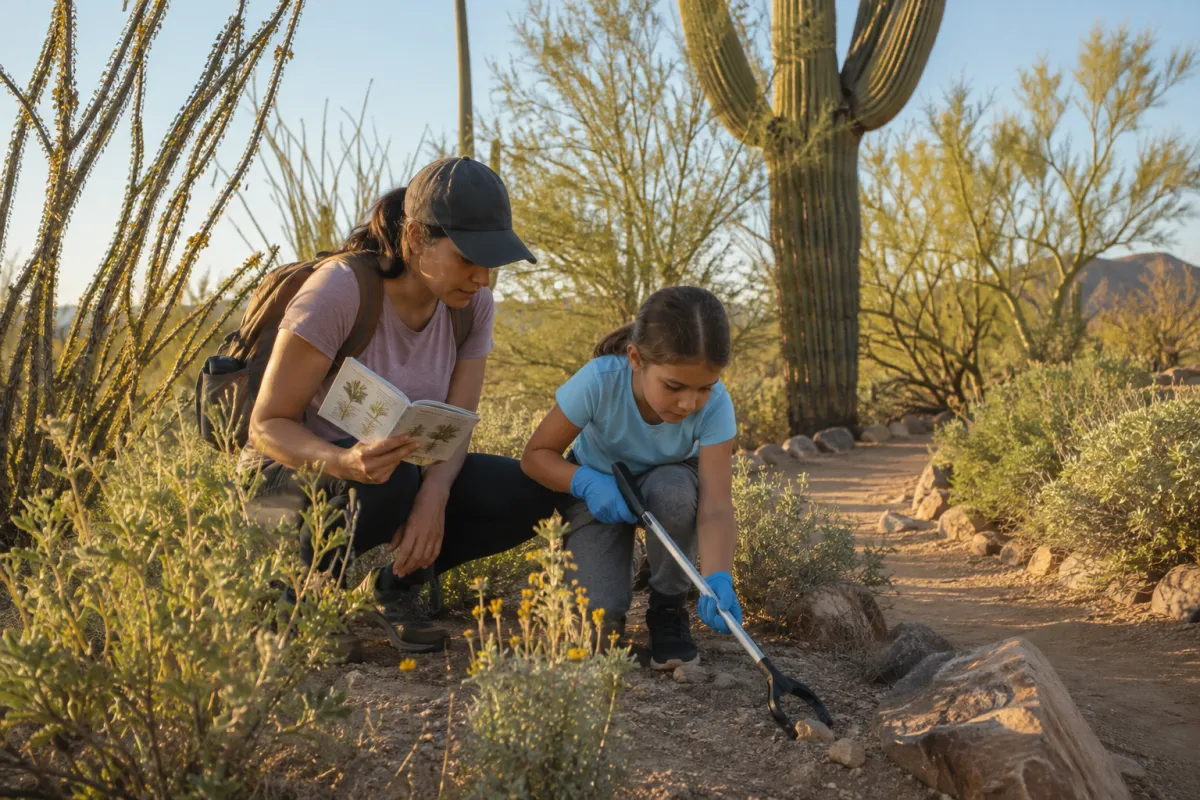
Use Arizona Junior Ranger Work to Teach Habitat Stewardship
What does one simple park rule reveal about the habitat it protects?
Stewardship becomes concrete when a child connects one park rule to the habitat, wildlife, or visitor it protects.
“Leave no trace” makes more sense when a child can explain who or what a rule protects. One Arizona park rule is enough to build that connection.
First, simplify the goal
Do this first: Review the Junior Ranger pledge before visiting and select one promise to investigate. During the visit, look for evidence showing why that promise matters, then create a small visitor guide in the child’s own words.
The facts worth carrying forward
Colorado River State Historic Park offers a downloadable Junior Ranger activity based on Morse code and the history of the Yuma Quartermaster Depot.
The park says children ages 6 through 12 can complete activities, have their work reviewed by a ranger, take the Junior Ranger pledge, and receive a button. Arizona State Parks notes that Junior Ranger opportunities are available at nearly all state parks.
The historic park occupies part of the Army depot established in 1864, which supplied military posts across the Southwest. Families should verify current programs, hours, fees, heat guidance, and accessibility before traveling.
Check before you act: Confirm the current park hours, fees, heat guidance, activity availability, and age fit before traveling. Treat the activity page as a starting point, not a promise that every program is running that day.
A focused homeschool route
Ask a ranger before collecting, touching, or leaving anything.
Record one example involving habitat, one involving wildlife, and one involving visitor safety.
Recommend an action that a child can realistically take without policing other visitors.
Finish with a child-written visitor card that links one park rule to habitat, wildlife, or visitor safety.
Invite one more question
What did you observe directly?
Which rule or condition shaped the visit?
What would you check before returning in another season?
When the obvious answer appears, ask what evidence could change it. That question keeps the activity from becoming a worksheet.
Different ages, same core thinking
For a younger child, trade the worksheet for three icons—noticed, wondered, and checked—and let the child dictate the details.
For an older child, keep time and conditions consistent, document uncertainty, and test the first identification against an official guide.
One honest explanation is more valuable than five rushed activities.
Do not let these mistakes steal the lesson
Chasing a better observation at the expense of wildlife, habitat, or safety.
Promising a program before checking the current park or museum details.
Recording only exciting results and quietly discarding uncertainty or a ‘nothing seen’ day.
Look for this kind of growth
The real payoff is growth in cause and effect reasoning and respectful public-land use. A strong finish is not a perfect page; it is a learner who can show how an idea changed when better evidence appeared.
The child should be able to explain the conclusion in plain language and identify the point where certainty ends.
Set it up today
Set out one Junior Ranger pledge promise to investigate during the visit. Write the learning question at the top of the page, complete the smallest useful version of the activity, and stop once the child can explain what the evidence supports and what remains uncertain.
Keep the finish small and visible: one claim, its evidence, its limit, and the question that should come next.